
Database Research & Development

  • Home
  • NoSQL
    • NoSQL
    • Cassandra
  • Databases
    • Database Theory
    • Database Designing
    • SQL Server Coding Standards
    • SQL Server
    • PostgreSQL
    • MySQL
    • Greenplum
    • Linux
  • Interviews
    • SQL Server Interviews
    • MySQL Interviews
    • SQL Puzzles
  • DBA Scripts
    • SQL Server DBA Scripts
    • PostgreSQL DBA Scripts
    • MySQL DBA Scripts
    • Greenplum DBA Scripts
  • Home
  • Blog Archives !
  • (: Laugh@dbrnd :)
  • Contact Me !
sqlserverinterviews
Home 2018 October SQL Server: Encrypt Password using HASHBYTES function

SQL Server: Encrypt Password using HASHBYTES function

This article is half-done without your Comment! *** Please share your thoughts via Comment ***

In this post, I am sharing the use of HASHBYTE() function in SQL Server. I am late for sharing this because HASHBYTE is not a new feature.

Recently, one developer asked few questions on TDE for specific column encryption. I suggested him to use HASHBYTE() and got to know that I didn’t share anything about it.

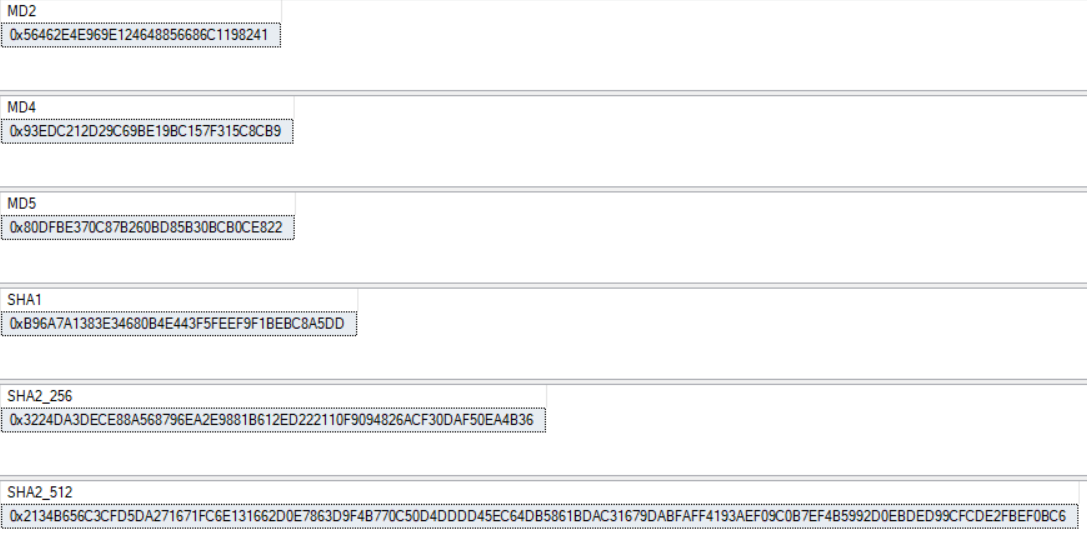
The HASHBYTE() returns the MD2, MD4, MD5, SHA, SHA1, or SHA2 hash of its input in SQL Server. You can use this algorithm for encrypting important column like a password.

SQL Server: Transparent Data Encryption (TDE) to Encrypt a Database

Examples:

1
2
3
4
5
6
SELECT HASHBYTES('MD2', 'dbrnd.com') AS MD2
SELECT HASHBYTES('MD4', 'dbrnd.com') AS MD4
SELECT HASHBYTES('MD5', 'dbrnd.com') AS MD5
SELECT HASHBYTES('SHA1', 'dbrnd.com') AS SHA1
SELECT HASHBYTES('SHA2_256', 'dbrnd.com') AS SHA2_256
SELECT HASHBYTES('SHA2_512', 'dbrnd.com') AS SHA2_512

SQL Server HASHBYTE

Oct 1, 2018Anvesh Patel
SQL Server: Generate the DROP Script for Table, Function, Stored Procedure, SchemaSQL Server: While execution, Debug the Code and Print the message
Comments: 1
  1. Sina
    August 19, 2019 at 2:37 am

    Hi,
    Thank you for the useful post, however I have a question.
    Is there any way to compare a hashbytes encryption in SQL Server with SHA1 with SHA1 encrypted string in MySQL !? Or how is it possible to do that?
    For instance:
    SQL Server example is:
    CONVERT(VARCHAR(50), HASHBYTES(‘SHA1’, ‘MyString’), 2)
    What’s equivalent in MySQL to reach the same result for comparison ?
    Thank you so much

    ReplyCancel

Leave a Reply Cancel reply

CAPTCHA
Refresh

*

Anvesh Patel

Database Engineer

October 1, 2018 1 Comment SQL ServerAnvesh Patel, Column encryption, database, database research and development, dbrnd, HASH Algorithm, HASHBYTE, password encryption, SQL Query, SQL Server, SQL Server Administrator, SQL Server Error, SQL Server Monitoring, SQL Server Performance Tuning, SQL Server Programming, SQL Server Tips and Tricks, TSQL
About Me!

I'm Anvesh Patel, a Database Engineer certified by Oracle and IBM. I'm working as a Database Architect, Database Optimizer, Database Administrator, Database Developer. Providing the best articles and solutions for different problems in the best manner through my blogs is my passion. I have more than six years of experience with various RDBMS products like MSSQL Server, PostgreSQL, MySQL, Greenplum and currently learning and doing research on BIGData and NoSQL technology. -- Hyderabad, India.

About DBRND !

dbrnd

This is a personal blog (www.dbrnd.com).

Any views or opinions represented in this blog are personal and belong solely to the blog owner and do not represent those of people, institutions or organizations that the owner may or may not be associated with in professional or personal capacity, unless explicitly stated.

Feel free to challenge me, disagree with me, or tell me I’m completely nuts in the comments section of each blog entry, but I reserve the right to delete any comment for any reason whatsoever (abusive, profane, rude, or anonymous comments) - so keep it polite.

The content of this website is protected by copyright. No portion of this website may be copied or replicated in any form without the written consent of the website owner.

Recent Comments !
  • Anvesh Patel { Sure will do... } – May 27, 12:43 PM
  • Anvesh Patel { Great... } – May 27, 12:41 PM
  • Anvesh Patel { Great... } – May 27, 12:39 PM
  • Anvesh Patel { Great... } – May 27, 12:36 PM
  • Anvesh Patel { Great... } – May 27, 12:28 PM
  • Anvesh Patel { Great... } – May 27, 12:27 PM
  • Anvesh Patel { Great... } – May 27, 12:16 PM
  • Older »
Follow Me !
  • facebook
  • linkedin
  • twitter
  • youtube
  • google
  • flickr
© 2015 – 2019 All rights reserved. Database Research & Development (dbrnd.com)
Posting....